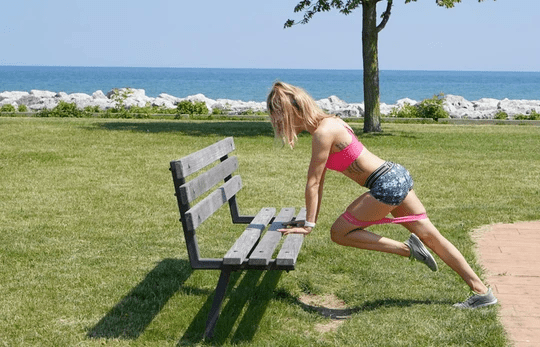
When you think of resistance bands, what comes to mind? Stretching, warming up, physical therapy?
All are valid answers. But, did you know that bands are actually very effective tools for building muscle?
Research has proven that resistance band exercises grow your muscles and tone them at the same time.
Toning your muscles is simply the process of losing body fat so that muscles appear on the surface of your skin.
There are no specific exercises to tone your muscles.
Resistance band exercises are versatile and cost-effective calorie burners.
They add resistance to movement and activate the muscle fibres. These Resistance bands workout are likely the best inexpensive
training tool you can get. Whether you are a beginner or already at an advanced fitness level, resistance band exercises
can give your muscles a good challenge.
Perfect Full Body Workout with Resistance Bands
Wide Grip Bicep Curls

1. Stand on the resistance band with leg width appropriate so tension will start with elbows close to your side and hands positioned out to the side more than the regular curl. See illustration. Holding handles palms up, curl as you would dumbbells. This will be your starting position.
2. Now, keeping the upper arms stationary, exhale and curl the weights while contracting your biceps. Continue to raise the weights until your biceps are fully contracted and the handles are at shoulder level. Hold the contracted position for a brief pause as you squeeze your biceps.
3. Then, inhale and slowly begin to lower the handles back to the starting position.
4. Repeat for the recommended amount of repetitions.
Upright Row

1. Grasp a handle in each hand grip that is slightly less than shoulder width. The handles should be resting on top of your thighs. Your arms should be extended with a slight bend at the elbows and your back should be straight. This will be your starting position.
2. Use your side shoulders to lift the handles as you exhale. The handles should be close to the body as you move it up and the elbows should drive the motion. Continue to lift them until they nearly touch your chin. Tip: Your elbows should drive the motion. As you lift the handles, your elbows should always be higher than your forearms. Also, keep your torso stationary and pause for a second at the top of the movement.
3. Lower the handles back down slowly to the starting position. Inhale as you perform this portion of the movement.
4. Repeat for the recommended amount of repetitions.
Overhead Press

1. Hold the resistance bands in each hand. Make sure to rotate your wrists so that the palms of your hands are facing forward. This is your starting position.
2. Now, exhale and push the handles dumbbells upward until you reach the lockout position.
3. Then, after a brief pause at the top contracted position, slowly lower the handles back down to the starting position while inhaling.
4. Repeat for the recommended amount of repetitions.
Tricep Push-Down

1. Attach the band to a high door anchor and grab the handles with an overhand grip (palms facing down) at shoulder width.
2. Standing upright with the torso straight and a very small inclination forward, bring the upper arms close to your body and perpendicular to the floor. This is your starting position.
3. Using the triceps, bring the bar down until it touches the front of your thighs and the arms are fully extended perpendicular to the floor. The upper arms should always remain stationary next to your torso and only the forearms should move. Exhale as you perform this movement.
4. After a second hold at the contracted position, bring the bar slowly up to the starting point.Breathe in as you perform this step.
Straight Arm Pull-Down

1. Attach the band to a high door anchor. Stand or kneel a couple of feet back from the door. Lean forward from the hip, keeping your back straight; with your arms extended up in front of you grab the handles at medium tension. This will be your starting position.
2. Keeping your arms straight, extend the shoulder to pull the handles down to your thighs.
3. Pause at the bottom of the motion, squeezing your lats.
4. Return to the starting position.
Band Crunch

1. Connect the band to a high door anchor and kneel below.
2. Grasp the handles and wrap the bands around your hand or adjust the length until your hands are placed next to your face with tension.
3. Flex your hips slightly and allow the weight to hyperextend the lower back. This will be your starting position.
4. With the hips stationary, flex the waist as you contract the abs so that the elbows travel towards the middle of the thighs. Exhale as you perform this portion of the movement and hold the contraction for a second.
5. Slowly return to the starting position as you inhale. Tip: Make sure that you keep constant tension on the abs throughout the movement. Also, do not choose a weight so heavy that the lower back handles the brunt of the work.
Side Sweeps

1. Secure both handles of the band to the lower portion of a door with the door anchor or by simply shutting the door with the handles on the outside of the under the section of the door if there is room. Step inside the loop of the band then takes a step or two over to create tension around your outside ankle.
2. Keeping your head and your chest up, move the resisted leg out to the side as far as you can while keeping the knee straight.
3. Return the leg to the starting position.
Squats

1. Bring the handles to your shoulders with a stance wide enough so tension is tight. This will be your starting position.
2. Looking straight ahead at all times, squat as low as you can and pause at the bottom. As you squat down, push your knees out. You should squat between your legs, keeping an upright torso, with your head and chest up.
3. Rise back up by driving through your heels and repeat for the recommended amount of reps.
Straight Leg Deadlifts

1. Begin by standing on the band and wrapping the excess band around your hand or adjusting the length so the tension is semi-tight on the bottom. This is your starting position.
2. The back should remain in absolute extension at all times, and your hands should remain close to your body. If done properly, there should be heavy tension felt in the hamstrings.
3. Reverse the motion to return to the starting position.
Reverse Lunges

1. Hold the bands in each hand with elbows out to the side and arms up. Make sure to rotate your wrists so that the palms of your hands are facing forward. Step one foot onto the band, the foot that you will not be using to lunge. This is your starting position.
2. Perform a rear lunge by stepping back with one foot and flexing the hips and front knee.
3. After a brief pause, return to the starting position and repeat on the other side, continuing for the recommended amount of reps then alternate to the other leg.
Side Raises

1. Stand on the resistance band with leg width appropriate so tension will start with arms straight down. Hold the handles with your palms facing in and your arms straight down at your sides at arms’ length. This will be your starting position.
2. While maintaining the torso stationary (no swinging), lift the handles to your side with a slight bend on the elbow and the hands slightly tilted forward as if pouring water in a glass. Continue to go up until your arms are parallel to the floor. Exhale as you execute this movement and pause for a second at the top.
3. Lower the handles back down slowly to the starting position as you inhale.
3 Essential Reminders When Doing Resisted Workouts
Make sure that the band can provide the right level of resistance you need for your workout.
- Make sure that you are really exerting close to the maximum effort each time you work out using the resistance band.
- Make sure that you keep maximum effort during your reps in order to reap
- the strengthening benefits of any resistance band workout for arms.


 workout routine resistance bands